

Understanding the types of hallucinations in schizophrenia, what they feel like, and why they happen is essential—not only for patients and families, but also for anyone seeking accurate mental health information.
Hallucinations are one of the most widely recognized—and often misunderstood—symptoms of schizophrenia. While popular culture tends to portray hallucinations as dramatic visual experiences, the reality is far more complex. People living with schizophrenia may experience hallucinations involving sound, sight, touch, smell, taste, or even bodily sensations, each affecting daily life in different ways.
What Is Schizophrenia and Why Are Hallucinations So Common?
Schizophrenia is a severe mental health condition that affects how a person thinks, feels, and perceives reality. It belongs to the schizophrenia spectrum, a group of psychotic disorders marked by disruptions in perception and cognition. One reason schizophrenia is so challenging is that hallucinations are often vivid, persistent, and emotionally distressing.
Many people with schizophrenia experience hallucinations as a core symptom, especially during active phases of psychosis. Schizophrenia typically affects perception by altering how the brain processes sensory input, making hallucinations feel real and convincing. This is why schizophrenia hallucinations can profoundly impact relationships, work, and self-care.
What Is a Hallucination and How Is It Defined in Mental Health?
A hallucination is a sensory experience that occurs without an external stimulus. Hallucinations are sensory experiences that can involve sound, sight, touch, taste, or smell. Unlike imagination, hallucinations feel real and are perceived as happening outside the mind.
In mental health, hallucinations are closely associated with psychotic states. Hallucinations may occur in conditions like schizophrenia, bipolar disorder, major depression with psychotic features, or brief psychotic disorder. Hallucinations involve seeing things, hearing sounds, or feeling sensations that others do not perceive.
Are Hallucinations a Core Symptom of Schizophrenia?
Yes, hallucinations are one symptom of schizophrenia, though not the only one. Alongside delusion, disorganized symptoms, and cognitive difficulties, hallucinations are considered a common symptom of the disorder.
Hallucinations and other symptoms often appear together, shaping the overall diagnosis of schizophrenia. While many people with schizophrenia experience hallucinations, schizophrenia may also involve periods without hallucinations, especially when treatment is effective.
Understanding Hallucinations in Schizophrenia
Hallucinations are sensory experiences that occur without an external stimulus. In schizophrenia, these experiences feel real to the person experiencing them, even though others cannot see, hear, or sense them.
Hallucinations in schizophrenia are different from imagination or daydreaming. They are involuntary, vivid, and often distressing. While hallucinations are a hallmark symptom, not every person with schizophrenia experiences them in the same way—or at all.
What Are Hallucinations in Schizophrenia?
From a medical and psychological perspective, hallucinations are defined as perceptions occurring in the absence of external reality. In schizophrenia, hallucinations are part of a broader condition involving changes in perception, thought processes, emotions, and behavior.
It is important to distinguish hallucinations from delusions.
- Hallucinations involve false sensory experiences (seeing or hearing things).
- Delusions involve false beliefs (such as paranoia or grandiosity).
Both symptoms may occur together, but they are not the same
What Do Schizophrenia Hallucinations Look Like?
A common question is: what do schizophrenia hallucinations look like? The answer depends on the type of hallucination.
Some people see detailed figures, shadows, or movements. Others hear voices commenting on their actions. Some feel sensations on their skin, while others smell odors that no one else detects. These experiences can feel realistic, confusing, and emotionally overwhelming.
Notably, some individuals do not realize they are hallucinating, especially during acute episodes, while others may retain partial insight.
The Most Common Type of Hallucination in Schizophrenia
The most common type of hallucination in schizophrenia is auditory hallucinations—specifically hearing voices. Research consistently shows that auditory hallucinations occur more frequently than visual or other sensory hallucinations.
Visual hallucinations do occur, but they are less common and often appear alongside other symptoms.
Types of Hallucinations in Schizophrenia Explained
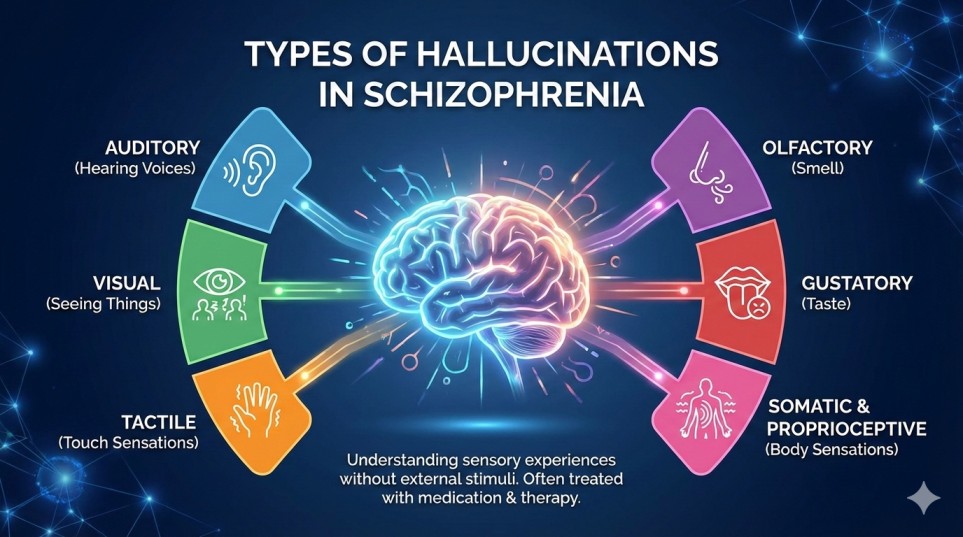
There are different types of hallucinations associated with schizophrenia, each affecting a different sense. The types of hallucinations in schizophrenia include auditory, visual, tactile, olfactory, gustatory, and multimodal hallucinations that involve more than one sense.
These various types of hallucinations differ in frequency and intensity. Auditory hallucinations are the most common type experienced, while others are considered less common. Understanding these distinctions helps explain the nature of hallucinations in people diagnosed with schizophrenia.
Auditory Hallucinations in Schizophrenia (Hearing Voices)
What Are Auditory Hallucinations?
Auditory hallucinations involve hearing sounds or voices that are not present. These voices may seem to come from inside the head or from the external environment.
Examples of Auditory Hallucinations
- Voices commenting on behavior
- Voices arguing with each other
- Command hallucinations telling the person to act
- Negative or critical voices
Many people ask, do schizophrenics hear voices all the time? The answer is no. Frequency and intensity vary greatly.
Why Do People With Schizophrenia Hear Voices?
Auditory hallucinations are linked to changes in brain regions responsible for language processing, perception, and dopamine regulation. Stress and trauma can intensify these experiences.
Visual Hallucinations in Schizophrenia
What Are Visual Hallucinations?
Visual hallucinations involve seeing things that are not physically present. These may include people, animals, shapes, lights, or moving objects.
Examples of Visual Hallucinations
- Seeing bugs crawling on the skin
- Seeing shadowy figures
- Distorted faces or environments
People often ask, do people with schizophrenia see things? Yes—though visual hallucinations are less common than auditory hallucinations.
Tactile (Touch) Hallucinations in Schizophrenia
Tactile hallucinations involve physical sensations without a physical cause. Individuals may feel:
- Bugs crawling under the skin
- Pressure or touch
- Heat, cold, or vibrations
These sensations can be extremely distressing and may overlap with delusional beliefs.
Olfactory Hallucinations (Smell Hallucinations)
Olfactory hallucinations involve smelling odors that are not present, such as smoke, chemicals, or rotting food. While less common, they can occur in schizophrenia and other neurological conditions.
Gustatory (Taste) Hallucinations
Gustatory hallucinations cause people to taste things without eating. Often described as metallic, bitter, or unpleasant, taste hallucinations usually occur alongside olfactory hallucinations.
Somatic and Proprioceptive Hallucinations
Somatic hallucinations involve internal bodily sensations, such as organs shifting or abnormal internal pressure. Proprioceptive hallucinations affect body awareness, making movements feel altered or disconnected.
What Are the 5–7 Types of Hallucinations?
Hallucinations are typically categorized into the following types:
- Auditory
- Visual
- Tactile
- Olfactory
- Gustatory
- Somatic
- Proprioceptive
These categories help clinicians understand symptom patterns and guide treatment.
What Are the 5–7 Types of Hallucinations?
Hallucinations are typically categorized into the following types:
- Auditory
- Visual
- Tactile
- Olfactory
- Gustatory
- Somatic
- Proprioceptive
These categories help clinicians understand symptom patterns and guide treatment.
How Long Do Hallucinations Last in Schizophrenia?
The duration of hallucinations varies. Some last seconds or minutes, while others persist for hours or recur daily. With proper treatment, hallucinations can become less intense or disappear entirely.
What Causes Hallucinations in Schizophrenia?
Hallucinations are linked to multiple factors, including:
- Dopamine imbalance
- Structural and functional brain differences
- Genetics
- Stress and trauma
- Substance use
Understanding these causes helps tailor effective treatment strategies.
Do All People With Schizophrenia Experience Hallucinations?
No. Some individuals experience primarily delusions or disorganized thinking without hallucinations. This is why schizophrenia presents differently from person to person.
Hallucinations vs Delusions in Schizophrenia
The key difference is perception versus belief. Hallucinations affect the senses; delusions affect interpretation of reality. Both can coexist and reinforce each other.
How Are Hallucinations in Schizophrenia Treated?
Treatment typically includes:
- Antipsychotic medication
- Psychotherapy (such as CBT for psychosis)
- Stress management
- Ongoing psychiatric care
Mental health providers, such as those at Altitude Behavioral Care, focus on individualized treatment plans that address hallucinations while supporting overall stability and quality of life.
How to Help Someone Experiencing Schizophrenia Hallucinations
- Stay calm and supportive
- Avoid arguing about the hallucination
- Encourage professional help
- Seek emergency assistance if safety is at risk
How Are Schizophrenia Hallucinations Treated and Managed?
Effective schizophrenia treatment focuses on reducing hallucinations and improving quality of life. Antipsychotic medications are the foundation of care, targeting dopamine pathways linked to psychosis. An antipsychotic can significantly reduce hallucinations.
Working with a mental health professional ensures proper medication management and therapy. Managing schizophrenia often involves psychotherapy, social support, and long-term care. Early treatment improves outcomes for those who receive a diagnosis of schizophrenia
Living With Hallucinations in Schizophrenia
While hallucinations can be frightening, they are treatable. With early intervention, consistent care, and proper support, many people with schizophrenia learn to manage symptoms and lead fulfilling lives